



VR Rehearsals Make for Perfect Practice
By Kris Hsu, Nightingale Innovations product manager of academic and innovative technology
Contrary to popular opinion, the heat of the moment doesn’t bring out your best performance. While it’s compelling to picture an adrenaline rush flipping a switch from flight to fight when the stakes are high, that reaction is far from guaranteed.
The reality is you perform at your best when you have rehearsed. Rehearsing helps train the mind to pause, reset, and respond.
For instance, which scenario sounds more comforting? Two planes encounter heavy turbulence and begin to lose altitude. In one, a pilot relies on an adrenaline jolt, doing their best in the moment to navigate the turbulence and land the plane safely. In the other, the pilot has faced this situation repeatedly through hours of simulation and knows exactly how to respond. There are no sweaty palms, racing heartbeats or frayed nerves—only calm, steady control. After all, this pilot has trained for this exact problem and understands precisely what to do.
How might that mindset translate to an educational setting, especially for those preparing for daily high-stake, life-or-death scenarios? Immersive technology offers a solution by combining storytelling with learning science to reinforce rehearsal under pressure.
Why (repeat) performance matters
Rehearsal builds muscle memory, preventing fear from taking over when it’s time to step up. Unlike actors on a film set, nurses deal with high-pressure situations in the healthcare system without the benefit of rehearsals and retakes.
Skilled test takers and capable learners can absorb the material and ace their exams, but how well does that prepare them for the emotional weight of real care when it truly matters? While administering an IV or medication may become routine, telling a family their loved one will not wake up is significantly more difficult.
Nurses are expected to enter traumatic situations with little rehearsal, creating a practice-to-theory gap that takes a toll not only on nurses, but on patients and their families as well.
Emotionally intelligent rehearsals can close that gap by providing learners with a safe space to face hard moments where they can pause, reflect, and repeat before confronted with real-life difficult situations. This is possible through virtual reality, which provides a story where you can create conflict-driven stakes grounded in real clinical practice.
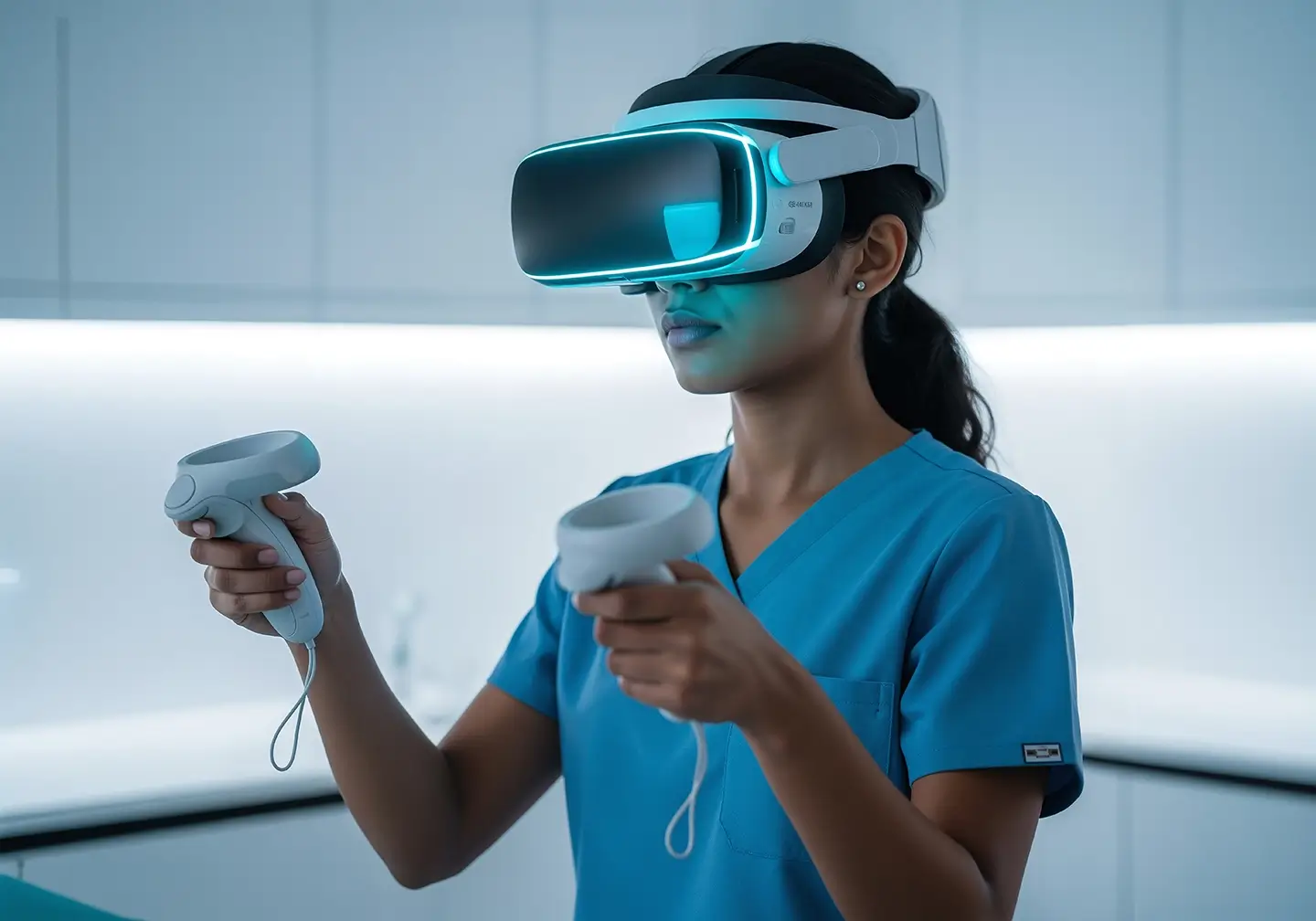
It is not just reading text but being immersed in a VR hospital with a patient seeking care. There is no prerecorded script. Instead, it’s powered by artificial intelligence (AI), which listens in real time and changes tone and emotion based on the learner’s response. The patient might start hyperventilating and a family member wants to speak with the learner. Now that slideshow lesson on a computer suddenly feels real instead of just a theoretical concept.
VR can help close the burnout gap
VR makes rehearsals scalable. Constructed scenarios are not limited by a single class session or a set number of users, allowing them to reach tens of thousands simultaneously.
Learners can put the headset back on and run the scenario again, anytime, getting additional practice with the same virtual patient or a different one. VR rehearsals reinforce the curriculum through repeated practice with realistic virtual patients.
While VR simulations serve as invaluable rehearsal tools, they cannot replace clinical rotations or faculty instruction. They do, however, allow learners to rehearse and repeat until their default response shifts from panic to calm, emotionally connected communication.
Replacing panic with an assured, measured response has never been more critical in nursing, as 20% of newly graduated nurses in the United States leave the profession within their first 2 years. That departure does not reflect a loss of passion for helping others—a commitment that rarely fades in just a couple of years. Research shows one of the key factors leading to those newer nurses staying is resilience: the ability to cope emotionally under stress.
Emotionally intelligent rehearsals can strengthen communication and judgment when stressors arrive. It is a significant asset to enhance resilience for nurses, but the practice and VR scenarios can just as easily be applied beyond the hospital to managers, social workers, teachers, first responders, and others.
Rehearsals help ensure compassion appears wherever people are asked to show up for one another under pressure. They offer a place to learn honestly, free from the illusion that perfection is possible or necessary.